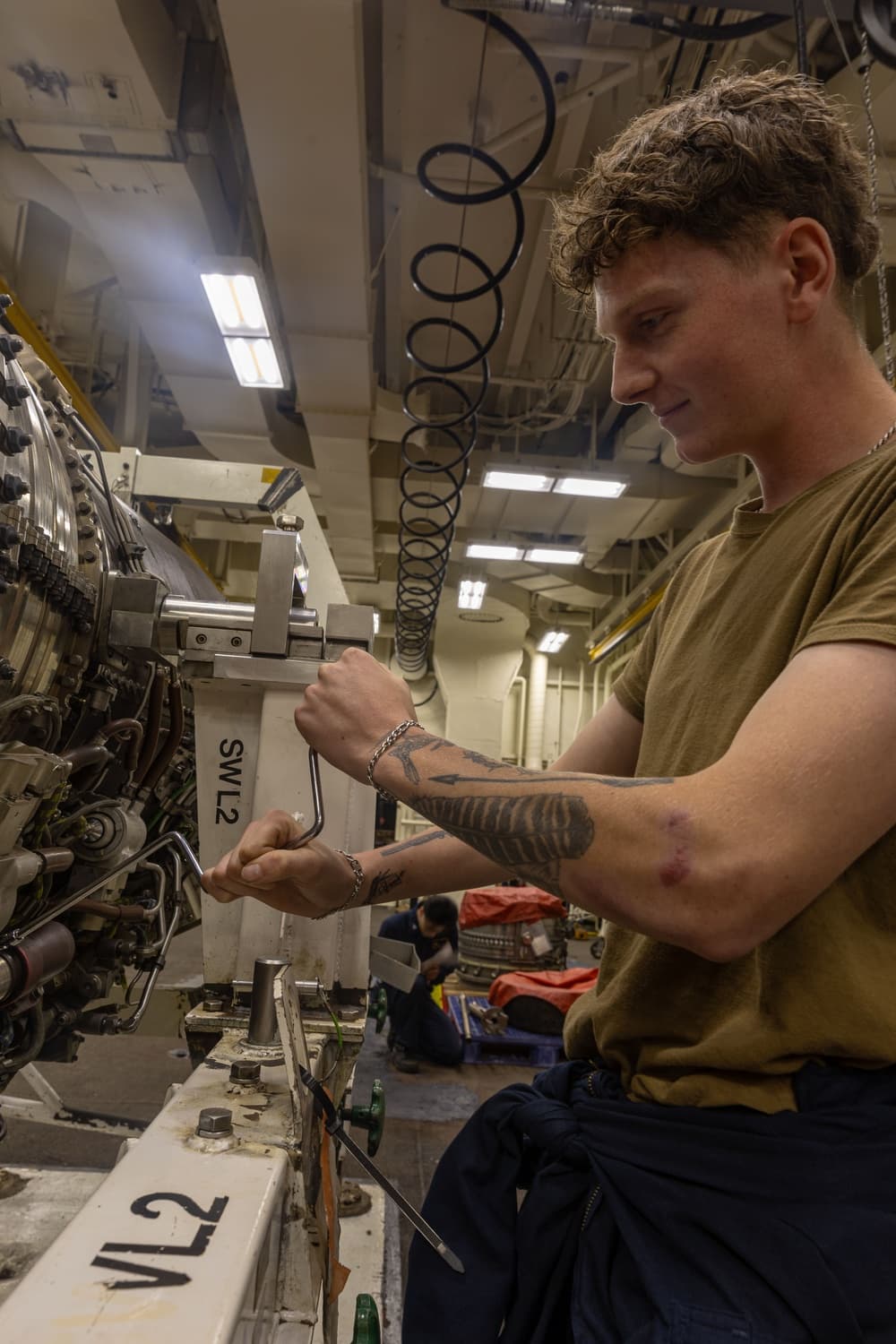
Aviation Machinist's Mate
Aviation Machinists Mates maintain and repair aircraft engines, propellers, and related systems. They perform scheduled and unscheduled maintenance on turbine engines, test cells, and power plants.
Overall
Quick Stats
Security Clearance
None
This rate does not require a security clearance.
ASVAB Requirements
Who This Is Best For
Best for hands-on problem solvers who enjoy diagnosing mechanical issues and want credentials that directly transfer to well-paying aerospace careers. If you like taking things apart and putting them back together, this rate builds A&P certification hours that airlines and defense contractors actively recruit for. Steady advancement with tangible, marketable skills.
+Pros
- ✓Strong civilian career transition
–Cons
Real Opinions
+Positive
“Great hands-on experience working on jet engines. The training you get is world class and transfers directly to civilian aviation maintenance jobs.”
“The skills I learned as an AD got me a six-figure job at a major airline within a year of getting out.”
“I would recommend AD to anyone considering it. The training is solid and the community takes care of its own.”
–Critical & Mixed
“Long hours on the flight deck, especially during deployment. 12-on 12-off is the norm at sea and it wears you down fast.”
“Like any rate, AD has its downsides. Long hours, time away from family, and Navy bureaucracy are real.”
“Long hours during deployment with no end in sight. As an AD you're responsible for engine maintenance and troubleshooting, which means when an aircraft is down, you don't leave until it's fixed regardless of how long you've been working. 14-16 hour days are common during high-tempo operations.”
“AD work is satisfying when things go right, but the noise exposure from running jet engines on the flight line takes a real toll. Hearing damage is almost guaranteed over a 4-year enlistment. The sea-shore rotation is heavily weighted toward sea duty for junior ADs, and the physical demands of working on engines in tight spaces wear on your body.”
Recruiter vs Reality
What the recruiter says vs. what it's actually like.
🫡 Recruiter says
“The AD rate offers great training and career advancement opportunities!”
💀 Reality
Source: MyNavyRates researchTraining and advancement are available but vary by command and manning. Ask specific questions about sea/shore rotation, typical duty stations, and advancement rates for AD.
🫡 Recruiter says
“AD is great for a career at Boeing or Pratt & Whitney.”
💀 Reality
Source: sailor forumsThe experience is relevant but civilian aviation companies require FAA A&P certification. The Navy will fund this through COOL but you have to apply and study for it yourself.
🫡 Recruiter says
“Aviation Machinists work on jet engines.”
💀 Reality
Source: veteran feedbackAD work on turbine engines is real but involves a lot of component teardown, inspection, and documentation in hangar bays. You are not flying the aircraft or even near them when they launch.
🫡 Recruiter says
“You'll be working on jet engines — it's like being a high-performance mechanic for fighter jets.”
💀 Reality
You will work on jet engines, but that often means removing and reinstalling engine components in extreme heat next to running APUs. The noise exposure is constant — up to 150 dB on the flight deck — and hearing damage is a genuine long-term occupational risk.
🫡 Recruiter says
“You'll get your A&P license and walk into airline jobs making great money.”
💀 Reality
Your experience helps toward an FAA A&P certificate, but the Navy does not hand you one. You still need to document hours, study on your own time, and pass the FAA exams yourself. Many ADs never get around to it while active duty.
🫡 Recruiter says
“You'll learn cutting-edge turbine engine technology used across the aviation industry.”
💀 Reality
You will learn turbine engines well, but A-school is only about 6 weeks. The real learning happens on the job over years. Don't expect to leave A-school feeling like an engine expert.
🫡 Recruiter says
“The work is hands-on and rewarding — you'll see the aircraft you fixed take off every day.”
💀 Reality
The work is hands-on, dirty, and physically demanding. You will be covered in hydraulic fluid, oil, and grease daily. You work around hot exhaust, intake zones, and pressurized systems. The rewarding part is real, but so is coming home smelling like JP-5 every day.
🫡 Recruiter says
“Boeing, Lockheed, and the airlines all recruit Navy engine mechanics.”
💀 Reality
Defense contractors and airlines do recruit AD veterans, but they recruit experienced ADs — typically E-5+ with 8+ years. A first-term AD at E-4 after four years is competitive but not a shoo-in.
🫡 Recruiter says
“You could be working on F/A-18s, F-35s, or helicopters — some of the most advanced aircraft in the world.”
💀 Reality
You don't choose your platform — the Navy does. You might get F/A-18s, H-60 helicopters, or end up at an FRC doing depot-level maintenance and never see a flight line. Your A-school strand narrows your path, and needs of the Navy drive the rest.
Training Pipeline — Total ~18 weeks (4 months)
Ship Date Calculator
Enter your MEPS ship date to see when you'll complete each stage.
Promotion SpeedEarn higher pay fasterSlowManning 92% (balanced)
| Cycle (Year) | Eligible | Selected | Promotion % |
|---|---|---|---|
| E-4252-Spring(2024) | 95 | 37 | 39% |
| E-4252-Fall(2024) | 213 | 93 | 44% |
| E-5252-Spring(2024) | 97 | 61 | 63% |
| E-5252-Fall(2024) | 166 | 26 | 16% |
| E-6252-Spring(2024) | 41 | 20 | 49% |
| E-6252-Fall(2024) | 43 | 28 | 65% |
Bonuses — Click here to see your military pay
Enlistment Bonus
No active bonus for this rate
You May Qualify for a Navy Enlisted Classification (NEC)
Specialties within this rate you can select, some with additional compensation. Each NEC has its own training, bonus potential, and career path.
Primary specialty code for Aviation Machinist's Mate rating
Advanced specialty code for experienced Aviation Machinist's Mate personnel
Potential Civilian Post-Navy Outcomes
Aircraft Mechanic
Transferability: 7.5/10
$52k–$85k
Free Certifications & Credentials
Certifications and licenses the Navy will pay for free through Navy COOL and on-the-job training.
FAA Airframe & Powerplant (A&P)
FAA
OSHA 30-Hour Safety
OSHA
Lifestyle6/10
Ship vs. Shore Split
55% / 45%
Deployment Frequency
Moderate
Physical Demand
high — mixed
Watch Standing
Flight schedule dependent, rotating duty days
Watch standing is a 24-hour duty rotation where sailors take turns manning critical positions aboard the ship or at their command. The rotation determines how frequently you stand watch and how much rest time you get between shifts.
Watch qualifications vary by command and platform. Expect to qualify within 90 days of reporting.
Common Duty Stations
—
Schools + spouse jobs
—
Avg waitlist for on-base
95
100 = national avg
—
Schools + spouse jobs
—
Avg waitlist for on-base
135
100 = national avg
—
Schools + spouse jobs
—
Avg waitlist for on-base
92
100 = national avg