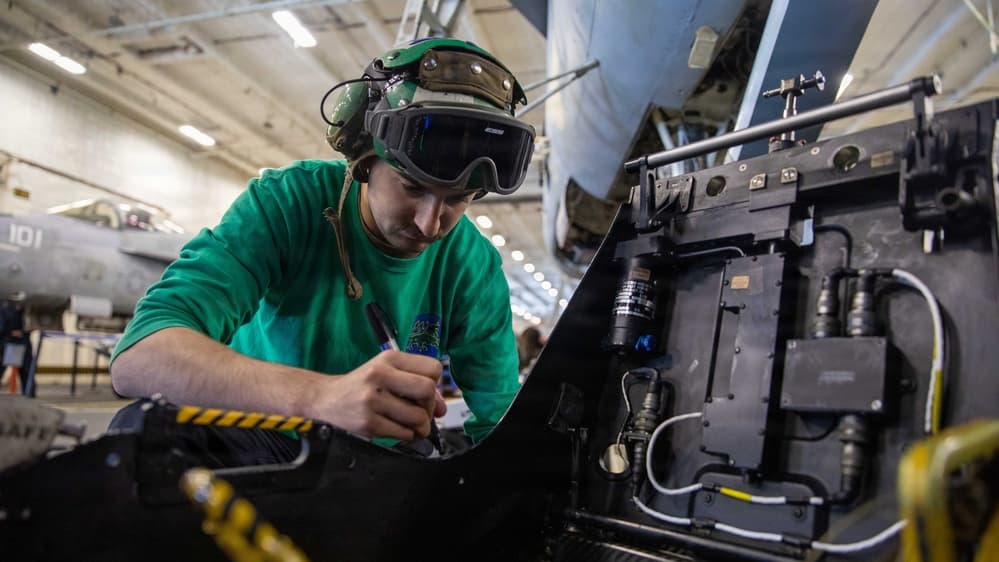
Aviation Structural Mechanic – Equipment
Maintains and repairs aviation life support equipment, ejection seats, and environmental systems on Navy aircraft.
Overall
Quick Stats
Security Clearance
Secret~$3K–$15K civilian sector value
Requires a National Agency Check with Local Agency Check and Credit Check (NACLC). Processing typically takes 1–3 months and is initiated early in your training pipeline.
ASVAB Requirements
Who This Is Best For
Best for meticulous, safety-obsessed individuals who want a specialized niche where attention to detail literally saves lives. If you take pride in perfect work and want skills few others possess, this rate offers a unique position within naval aviation with strong transfer potential to aerospace safety engineering.
+Pros
- ✓Strong civilian career transition
–Cons
Real Opinions
+Positive
“I would recommend AME to anyone considering it. The training is solid and the community takes care of its own.”
“Great hands-on training working with hydraulics, pneumatics, and aircraft structures. AME gives you real mechanical skills that transfer directly to civilian aerospace jobs. The feeling of fixing something that keeps pilots safe is genuinely rewarding.”
“AME training prepares you for FAA Airframe and Powerplant certification, which is one of the most valuable aviation credentials in the civilian world. Many former AMEs walk directly into airline maintenance jobs earning $60K-$80K starting.”
–Critical & Mixed
“Like any rate, AME has its downsides. Long hours, time away from family, and Navy bureaucracy are real.”
“The work is physically demanding — you're crawling into tight spaces, working with hazardous materials like composites and solvents, and standing on your feet for 12+ hours during deployment. The chemical exposure concerns are real and leadership doesn't always prioritize proper PPE.”
“Advancement for AME can be slow because the community is relatively small. You're competing against other skilled maintainers for limited quotas. The sea-shore rotation is heavily sea-weighted for junior sailors, meaning years on a carrier before you see shore duty.”
Recruiter vs Reality
What the recruiter says vs. what it's actually like.
🫡 Recruiter says
“The AME rate offers great training and career advancement opportunities!”
💀 Reality
Source: MyNavyRates researchTraining and advancement are available but vary by command and manning. Ask specific questions about sea/shore rotation, typical duty stations, and advancement rates for AME.
🫡 Recruiter says
“AME is one of the safest aviation rates.”
💀 Reality
Source: sailor forumsAME works in shop environments rather than the flight deck, which is safer. But the pressure of maintaining life-critical equipment creates its own stress.
🫡 Recruiter says
“AME works on aircraft ejection seats and life support systems.”
💀 Reality
Source: veteran feedbackAME maintains critical safety equipment: ejection seats, oxygen systems, and survival gear. The responsibility is enormous because a failure means someone dies. The work is meticulous and documentation-heavy.
🫡 Recruiter says
“"Your recruiter knows what's best for you — trust the process."”
💀 Reality
Your recruiter's job is to fill contracts, not to optimize your career. They get credit for every contract signed, regardless of whether the rate is a good fit for you. Do your own research on r/newtothenavy, talk to people who actually hold the rate, and never let anyone else decide what you do for the next four to six years of your life.
🫡 Recruiter says
“"The Navy will teach you everything you need — no experience required."”
💀 Reality
Source: general_red_flagThe Navy teaches you their way, which often does not translate directly to civilian credentials. You still need to pursue certifications, licenses, and degrees on your own time.
🫡 Recruiter says
“"This rate is basically the same as a civilian job."”
💀 Reality
Source: general_red_flagMilitary versions of civilian jobs operate under completely different constraints — 24/7 availability, chain of command approval for everything, and no ability to quit. The job title may sound similar but the experience is fundamentally different.
🫡 Recruiter says
“"Nobody actually reads the contract — just sign where I point."”
💀 Reality
Source: general_red_flagRead every word. The contract specifies your rate, enlistment length, and bonus. If something the recruiter promised is not in the contract, it does not exist. This is the most important document you will sign before age 25.
🫡 Recruiter says
“"The barracks are nice — they've been renovated recently."”
💀 Reality
Source: general_red_flagSome barracks are renovated and decent. Others have black mold, broken HVAC, and roach problems. The quality of your living conditions is a lottery based on your base.
🫡 Recruiter says
“"Once you finish your contract, you're completely done."”
💀 Reality
Source: general_red_flagAfter active duty, you enter the Individual Ready Reserve (IRR) for the remainder of your 8-year Military Service Obligation. You can technically be recalled. Full separation takes 8 years from your enlistment date.
🫡 Recruiter says
“"The Navy has the best technology — you'll be working with state-of-the-art equipment."”
💀 Reality
Source: general_red_flagMany systems are legacy from the 1980s and 1990s held together with creative maintenance. You will become an expert at making old equipment work, not always at operating new technology.
Training Pipeline — Total ~20 weeks (5 months)
Ship Date Calculator
Enter your MEPS ship date to see when you'll complete each stage.
Promotion SpeedEarn higher pay faster—Manning 91% (E-5/E-6)
| Cycle (Year) | Eligible | Selected | Promotion % |
|---|---|---|---|
| E-4252-Spring(2024) | 222 | 71 | 32% |
| E-4252-Fall(2024) | 136 | 26 | 19% |
| E-5252-Spring(2024) | 168 | 27 | 16% |
| E-5252-Fall(2024) | 62 | 13 | 21% |
| E-6252-Spring(2024) | 105 | 40 | 38% |
| E-6252-Fall(2024) | 148 | 6 | 4% |
Bonuses — Click here to see your military pay
Enlistment Bonus
No active bonus for this rate
You May Qualify for a Navy Enlisted Classification (NEC)
Specialties within this rate you can select, some with additional compensation. Each NEC has its own training, bonus potential, and career path.
Primary specialty code for Aviation Structural Mechanic – Equipment rating
Advanced specialty code for experienced Aviation Structural Mechanic – Equipment personnel
Potential Civilian Post-Navy Outcomes
Aviation Safety Equipment Technician
Transferability: 7/10
$45k–$75k
Lifestyle5/10
Ship vs. Shore Split
55% / 45%
Deployment Frequency
Moderate
Physical Demand
medium — indoor
Watch Standing
Flight schedule dependent, rotating duty days
Watch standing is a 24-hour duty rotation where sailors take turns manning critical positions aboard the ship or at their command. The rotation determines how frequently you stand watch and how much rest time you get between shifts.
Watch qualifications vary by command and platform. Expect to qualify within 90 days of reporting.