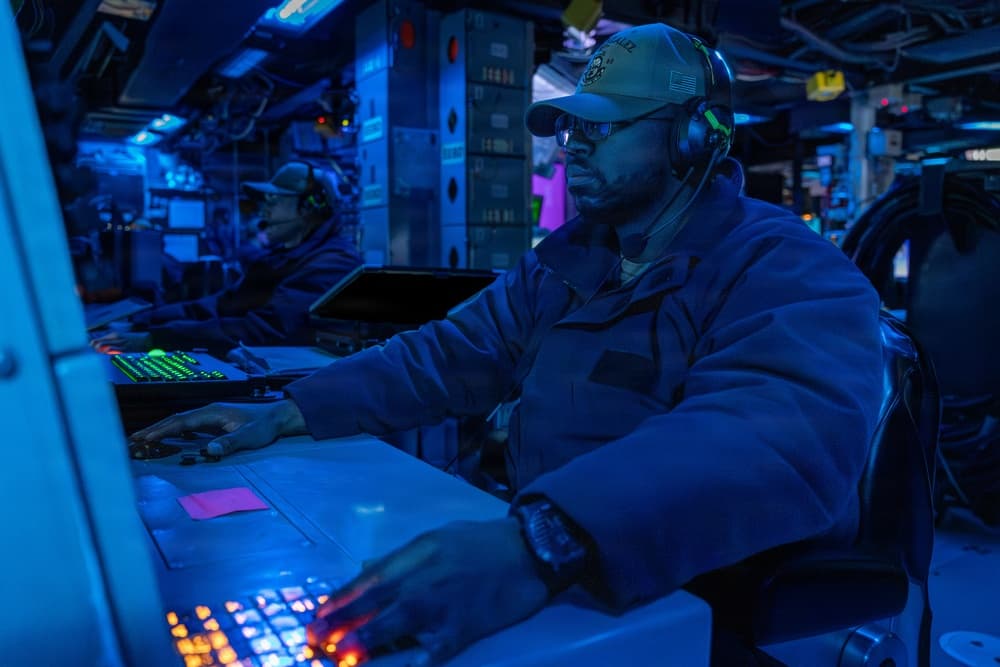
Fire Controlman – Aegis
Operates and maintains the Aegis Combat System, SPY radar, and Standard Missile launching systems aboard guided missile cruisers and destroyers.
Overall
Quick Stats
Security Clearance
Secret~$3K–$15K civilian sector value
Requires a National Agency Check with Local Agency Check and Credit Check (NACLC). Processing typically takes 1–3 months and is initiated early in your training pipeline.
ASVAB Requirements
Who This Is Best For
Best for elite electronics operators who want to master the most sophisticated integrated combat system in the world. Defense contractors like Lockheed Martin and Raytheon actively recruit former FCA sailors, making this a premier technical rate with outstanding civilian career prospects. Ideal for detail-oriented, system-level thinkers.
+Pros
- ✓Strong civilian career transition
–Cons
- ✗Long A-school pipeline
- ✗Significant sea duty
Real Opinions
+Positive
“The work is challenging, technical and requires a steady hand. You will operate, maintain and control everything from radars, fire control systems and computer systems to the Navy most advanced missile system.”
“Many Fire Controlmen stay in their jobs for a long time because the work is challenging and they have good chances for civilian jobs later.”
“I would recommend FCA to anyone considering it. The training is solid and the community takes care of its own.”
–Critical & Mixed
“Like any rate, FCA has its downsides. Long hours, time away from family, and Navy bureaucracy are real.”
“The FCA billet base at E5 is imbalanced for shore duty, which may prevent a Sailor's opportunity for an in-rate shore tour. Aegis manning structure aboard a ship limits opportunity to serve in Leading Petty Officer positions.”
“High responsibility during combat or alert states means mistakes have severe consequences. Diagnostics are time-critical with pressure to repair during limited maintenance windows. The long A-school pipeline and Aegis-specific training lock you into a very narrow career path.”
Recruiter vs Reality
What the recruiter says vs. what it's actually like.
🫡 Recruiter says
“The FCA rate offers great training and career advancement opportunities!”
💀 Reality
Source: MyNavyRates researchTraining and advancement are available but vary by command and manning. Ask specific questions about sea/shore rotation, typical duty stations, and advancement rates for FCA.
🫡 Recruiter says
“FCA is the most technically demanding weapons rate.”
💀 Reality
Source: sailor forumsTrue, but the Aegis system is complex and the troubleshooting can be frustrating. You are responsible for a system that costs billions and the pressure to keep it operational is constant.
🫡 Recruiter says
“FCA works on the Aegis combat system.”
💀 Reality
Source: veteran feedbackFCA maintains the most advanced naval combat system in the world. The technical knowledge is deep and specialized. Civilian Aegis contractors pay well for this experience.
🫡 Recruiter says
“FCAs maintain the most powerful radar at sea — the SPY-1.”
💀 Reality
The AN/SPY-1 radar is genuinely the most capable ship-based radar in the fleet. But maintaining it means dealing with a system that has thousands of components, aging baselines on older cruisers, and cooling water systems that constantly need attention. When SPY goes down, the ship loses its primary air defense capability, and you will feel every minute of pressure from the CO until it is back up.
🫡 Recruiter says
“FCA can serve on any surface combatant.”
💀 Reality
FCAs are locked into Aegis-equipped platforms: Ticonderoga-class cruisers and Arleigh Burke-class destroyers. As Ticos decommission, your platform options narrow further to DDGs until DDG(X) comes online. Shore duty billets often mean Aegis Training Centers (Dahlgren, VA or Moorestown, NJ). You will not get the variety of duty stations that a regular FC sees.
🫡 Recruiter says
“Aegis experience sets you up for a great civilian career in defense.”
💀 Reality
Aegis contractors (Lockheed Martin, BAE, Leidos) do actively recruit experienced FCAs, and the pay can be strong — but you need deep system knowledge, typically at the E-6/E-7 level with multiple baselines. Junior FCAs leaving after one enlistment have solid electronics fundamentals but rarely the depth contractors want for Aegis-specific work.
Training Pipeline — Total ~30 weeks (7 months)
Ship Date Calculator
Enter your MEPS ship date to see when you'll complete each stage.
Promotion SpeedEarn higher pay faster—Manning 83%
| Cycle (Year) | Eligible | Selected | Promotion % |
|---|---|---|---|
| E-4252-Spring(2024) | 136 | 63 | 46% |
| E-4252-Fall(2024) | 107 | 114 | 107% |
| E-5252-Spring(2024) | 119 | 23 | 19% |
| E-5252-Fall(2024) | 110 | 42 | 38% |
| E-6252-Spring(2024) | 114 | 12 | 11% |
| E-6252-Fall(2024) | 50 | 36 | 72% |
Bonuses — Click here to see your military pay
Enlistment Bonus
No active bonus for this rate
You May Qualify for a Navy Enlisted Classification (NEC)
Specialties within this rate you can select, some with additional compensation. Each NEC has its own training, bonus potential, and career path.
Primary specialty code for Fire Controlman – Aegis rating
Advanced specialty code for experienced Fire Controlman – Aegis personnel
Potential Civilian Post-Navy Outcomes
Radar Systems Engineer
Transferability: 7/10
$55k–$95k
Lifestyle4/10
Ship vs. Shore Split
65% / 35%
Deployment Frequency
High
Physical Demand
medium — indoor
Watch Standing
3-section underway (8 on / 16 off)
In a 3-section rotation, the crew is divided into three teams. Each team stands an 8-hour watch shift, then has 16 hours off. In port, you stand 24-hour duty roughly every 3 days — one out of every three nights you stay aboard the ship. Underway (when attached to a ship command), the watch schedule runs continuously with shorter rest periods between shifts.
Watch qualifications vary by command and platform. Expect to qualify within 90 days of reporting.